

Most founders obsess over the idea. They refine it, workshop it, pitch it to friends who nod politely. But understanding why timing matters in business creation may be the most underrated edge in entrepreneurship. Timing accounts for 42% of the difference between startup success and failure, outperforming both team quality and idea quality. That number should stop you cold. It means a mediocre idea launched at exactly the right moment will outperform a brilliant idea launched too early or too late. This guide breaks down the research, the frameworks, and the practical moves that turn timing from a guessing game into a skill.
Table of Contents
- The science behind timing in startup success
- First movers vs. fast followers: timing strategies that shape outcomes
- Measuring timing: frameworks and tools to assess market readiness and entry
- Timing windows, execution discipline, and managing growth risks
- Why timing is the overlooked skill every founder must master
- How Founder Zero helps you master business timing and execution
- Frequently asked questions
Key Takeaways
| Point | Details |
|---|---|
| Timing dominates success | Timing accounts for about 40% of business success, more than idea or team quality combined. |
| Fast following often wins | Many successful companies are not first movers but optimally timed fast followers. |
| Use data-driven frameworks | Frameworks like the T-Score help objectively assess market readiness for launch. |
| Delay premature scaling | Avoid costly early hires until revenue confirms product-market fit and market timing. |
| Timing is a skill | Mastering timing requires observation, data, and strategic discipline, not luck alone. |
The science behind timing in startup success
For years, the startup world treated timing as a soft variable. Something you either got lucky with or didn't. Then the data arrived.
Bill Gross, founder of Idealab, analyzed over 200 companies across five factors: idea, team, business model, funding, and timing. His conclusion was stark. Timing was the single biggest predictor of success. Harvard Business School research reinforces this, finding that timing drives roughly 40% of startup success variance, while people and plan quality each account for closer to 30%.
"Timing is not just a factor in startup success. It is the factor. The data consistently shows that launching into a ready market beats launching with a superior product into an unready one."
What makes this insight so useful is that timing is not purely random. It is partially controllable. Founders who study market signals, technology adoption curves, and regulatory shifts can position themselves to enter at the moment of maximum readiness. That is not luck. That is pattern recognition applied as strategy. Platforms built around business launch insights exist precisely to help founders read these signals before committing resources.
The implication for you: before you spend six months building, spend six weeks asking whether the market is ready for what you are building.
First movers vs. fast followers: timing strategies that shape outcomes
The myth of the first mover advantage is one of the most expensive beliefs in startup culture. Being first sounds like a competitive moat. The data says otherwise.
47% of market pioneers failed, and many of the companies that eventually dominated their categories entered years after the pioneers had already done the painful work of educating the market. Google was not the first search engine. Apple did not invent the MP3 player or the smartphone. They entered when the market was primed, when consumers understood the category, and when the technology had matured enough to deliver a reliable experience.
The reason pioneers struggle comes down to cost. First movers bear 60 to 75% higher costs to educate markets, which allows fast followers to achieve 3 to 10 times better customer acquisition costs. That gap is often fatal for early entrants who burn through capital explaining why the product exists before they can focus on why it is better.

Comparing first mover vs. fast follower outcomes
| Factor | First mover | Fast follower |
|---|---|---|
| Market education cost | Very high | Low to moderate |
| Customer acquisition cost | 3 to 10× higher | Baseline |
| Failure rate | ~47% | Significantly lower |
| Brand recognition risk | High (category confusion) | Lower (category exists) |
| Window to enter | Narrow, uncertain | Broader, data-informed |
The fast follower advantage is not about being lazy or unoriginal. It is about entering a market entry timing window where the groundwork is already laid. Your resources go toward differentiation and growth rather than explanation and persuasion.
Key questions to determine your timing position:
- Has a pioneer already spent money educating your target customer?
- Is the technology your product depends on now reliable and affordable?
- Are customers actively searching for solutions in your category?
- Have regulatory or infrastructure barriers recently dropped?
- Can you enter with a meaningfully better product, not just a similar one?
If you answer yes to most of these, you are not late. You are positioned.
Measuring timing: frameworks and tools to assess market readiness and entry
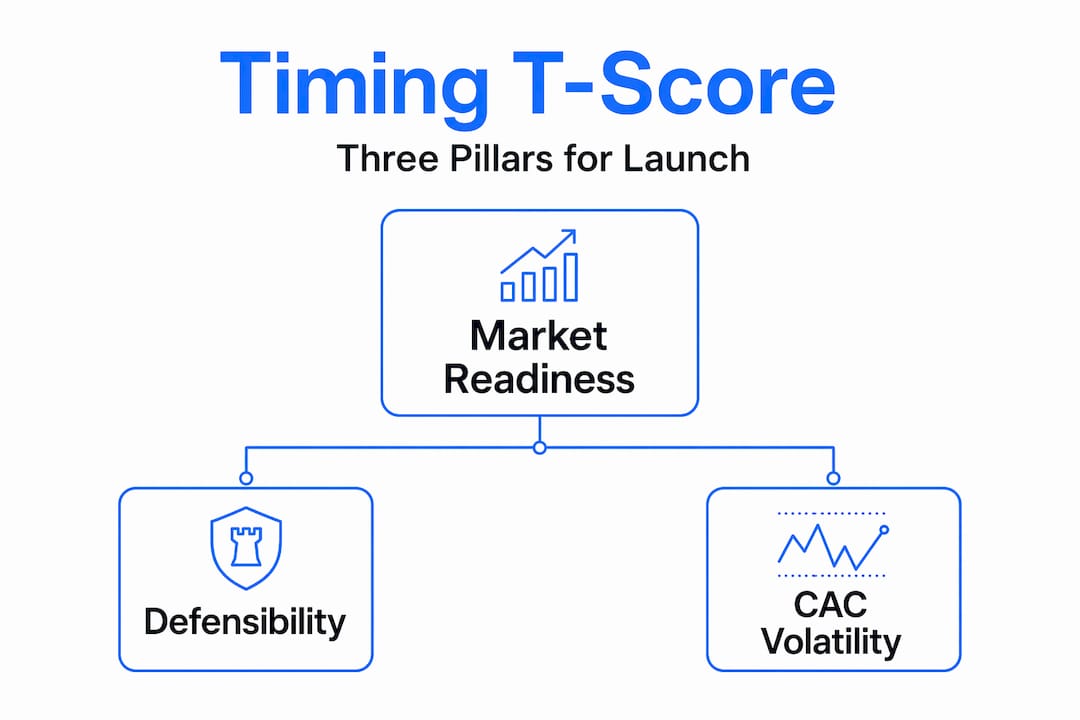
Knowing that timing matters is one thing. Measuring it is another. The T-Score framework gives founders a structured way to quantify their timing position before committing to a launch.
The T-Score combines three variables: Market Readiness (how prepared buyers are to adopt your solution), Defensibility (how protected your position is from fast followers once you enter), and CAC Volatility (how stable or erratic your customer acquisition costs are in the current environment). Using the T-Score to combine these factors allows data-driven timing decisions that measurably improve success rates.
T-Score timing zones and expected outcomes
| T-Score range | Timing zone | Expected outcome |
|---|---|---|
| 12 to 15 | Optimal | High success probability, efficient CAC |
| 8 to 11 | Acceptable | Moderate success, manageable costs |
| 5 to 7 | Risky | High education burn, elevated failure risk |
| Below 5 | Premature | Very high costs, market not ready |
How to calculate your T-Score in four steps:
- Score Market Readiness (1 to 5): Survey potential customers. Are they already aware of the problem? Are they actively seeking solutions? A score of 5 means they are ready to buy now.
- Score Defensibility (1 to 5): Can you hold your position once you enter? Consider proprietary data, switching costs, network effects, or regulatory advantages.
- Score CAC Stability (1 to 5): Look at paid channel costs in your category. Are they stable and predictable, or spiking and unpredictable? Stable gets a higher score.
- Add the three scores. Your total is your T-Score.
Pro Tip: Avoid launching if your T-Score is below 8. A low score means you will spend disproportionate resources educating the market rather than acquiring customers, which is the fastest way to burn your runway without generating signal.
The hardest variable to estimate accurately is Market Readiness. Founders consistently overestimate it because they are close to the problem. Use a launch planning tool to model demand signals objectively, not just validate your own assumptions.
Timing windows, execution discipline, and managing growth risks
Here is a distinction most timing articles miss: speed in learning matters more than speed in entering. Getting to market fast is valuable only if you are learning fast once you are there. Rushing to launch before you can measure anything is not a timing advantage. It is noise.
Veteran founders optimize timing by targeting specific windows, distinguishing between speed and premature entry, and delaying hiring until revenue pipelines confirm demand. That last point is worth sitting with. Most early-stage founders treat hiring as a signal of seriousness. Veteran founders treat it as a liability until the numbers justify it.
Timing disciplines that separate sustainable startups from ones that stall:
- Maintain 12 to 18 months of runway before your first major push. Timing windows rarely open and close in 90 days. You need staying power.
- Sequence your launch. A soft launch to a narrow segment before a broad release gives you real data without full exposure.
- Delay non-compounding decisions. Broad hiring, office leases, and brand campaigns do not compound early. Revenue does. Prioritize accordingly.
- Watch for premature scale signals. If you are hiring to handle growth before the growth is confirmed, you are betting on a timing assumption, not a timing fact.
One-person startups should avoid payroll until revenue pipelines confirm demand. This is not about being cheap. It is about keeping your feedback loop clean. Every dollar spent on salaries before product-market fit is a dollar that obscures whether your timing is actually right.
Pro Tip: Track revenue per week, not per quarter, in your first six months. Weekly revenue data tells you whether your timing is working far faster than any lagging indicator.
The founders who navigate timing well are not the ones who move fastest. They are the ones who stay solvent long enough to find the window, then move decisively when it opens. That requires financial discipline as much as market insight. Use startup growth strategies that account for runway as a timing variable, not just a financial one.
Why timing is the overlooked skill every founder must master
Most founders treat timing as something that happens to them. The market was ready, or it wasn't. The economy cooperated, or it didn't. This framing is comfortable because it removes responsibility. It is also wrong.
Timing isn't luck. Founders who develop timing skills through data and observation can seize strategic windows others miss. That is a learnable capability, not a personality trait or a fortunate circumstance. The founders who consistently time their entries well are not psychic. They are disciplined observers who track technology adoption, consumer behavior shifts, and regulatory changes the way a surfer watches wave patterns.
The first-mover myth is where the most money gets wasted. Founders race to launch because they fear being beaten to market, when the data shows that entering a prepared market is almost always more efficient than creating one from scratch. Moving second can be strategic maturity, not hesitation. The founders who understand this stop racing and start reading.
There is also a capability alignment problem that rarely gets discussed. Even if your timing is perfect and the market is ready, launching before your team has the operational capacity to deliver consistently will waste the window. Timing, execution, and capability have to align. A great window with a team that cannot fulfill demand is not an advantage. It is a reputation risk.
The practical shift is this: before your next launch decision, ask not "is our product ready?" but "is the market ready, are we ready, and do those two things overlap right now?" That overlap is where founder timing insights become real competitive advantage.
How Founder Zero helps you master business timing and execution
Knowing the theory of timing is useful. Having a system that applies it to your specific idea, market, and resources is what actually changes outcomes.
Founder Zero is built for exactly this problem. The platform analyzes market signals, demand patterns, and competitive positioning to tell you whether your timing is right before you commit to building. If your idea is premature, you will know before you burn six months on it. If the window is open, you will have a sequenced launch plan that maximizes your runway and focuses your first moves on the actions most likely to generate early revenue. You can start with a free assessment to get an immediate read on your best business direction, then move into a full plan when the timing is confirmed. Visit the Founder Zero platform to run your first timing check today.
Frequently asked questions
Why is timing more important than the idea in business success?
Market readiness and external conditions often determine whether an idea can gain traction at all. Timing accounts for 42% of success variance, which means even a strong idea will fail if the market is not ready to receive it.
What is the risk of launching a business too early?
Launching before the market is ready forces you to spend heavily on customer education rather than customer acquisition. Too early entry increases costs by 2 to 4 times and significantly raises failure risk due to market education burn.
How can a founder assess the best timing to launch?
The T-Score framework gives founders a structured way to evaluate market readiness, defensibility, and CAC volatility before launching. The T-Score framework quantifies these key timing factors to help founders make data-driven launch decisions rather than gut-based ones.
Should startups hire large teams early to capitalize on market windows?
No. Expanding the team before revenue pipelines are confirmed is one of the most common ways founders waste their timing advantage. One-person startups should avoid payroll until revenue pipelines confirm real demand.
Do first movers always win the market?
Rarely. The data shows that 47% of pioneers failed, while fast followers who entered with refined products and better market conditions consistently achieved stronger outcomes and lower acquisition costs.