

Most founders build first and ask questions later. That's not ambition. That's how you spend 18 months and $80,000 building something nobody wants. What is idea validation in startups? It's the structured process of testing whether a real, painful problem exists before you commit serious time, money, or reputation to solving it. Not a gut check. Not a poll in a Facebook group. A disciplined, evidence-based investigation that separates promising ideas from expensive mistakes. The stakes are high, and validated startups hold a measurable advantage from day one.
Table of Contents
- Key takeaways
- What idea validation in startups actually means
- The practical idea validation process
- Common pitfalls that mislead founders
- Turning validation results into decisions
- My take on why founders avoid real validation
- Test your idea before you build it with Founderzero
- FAQ
Key takeaways
| Point | Details |
|---|---|
| Problem first, solution second | Validate that a painful, real problem exists before testing whether your solution works. |
| Behavior beats opinion | Real validation comes from money or time committed, not compliments or survey responses. |
| Use the 2-20-200 framework | Stage your validation effort to manage risk before spending hundreds of hours on development. |
| False signals are everywhere | Waitlists and positive feedback feel encouraging but carry zero predictive value for revenue. |
| Validation informs decisions | Your validation results should directly tell you whether to build, pivot, or walk away. |
What idea validation in startups actually means
Most people think idea validation means asking friends if your idea is good and getting excited when they say yes. That framing is wrong in a specific and dangerous way. True validation is not about confirming your idea is good. It's about proving there is a real, painful problem that customers will pay to solve.
That distinction matters more than it sounds. The idea is just a proposed solution. The problem is what actually drives purchasing behavior. If you validate the solution before validating the problem, you are building a bridge before checking whether anyone needs to cross the river.

Problem validation vs. solution validation
Problem validation asks the foundational questions: Is this problem real? Does it happen frequently? Is it painful enough that people actively look for solutions? Would solving it be worth paying for? Solution validation comes later, and only after you have solid affirmative answers to those questions.
Skipping problem discovery and jumping straight to solution testing causes founders to miss unbiased insights about the core problem. You end up building a product shaped by your assumptions rather than customer reality. The fix is deceptively simple. Write your assumptions down explicitly. If they stay implicit, they cannot be tested, and you carry hidden risks from beliefs you have never challenged.
The four questions worth asking at this stage are:
- Is the problem real and documented in the market?
- Is it painful enough to disrupt someone's current behavior?
- Are people already spending money on imperfect workarounds?
- Can you reach and serve this customer segment profitably?
Pro Tip: When you write down your assumptions, treat each one as a hypothesis that must be disproved. Validation is not a search for confirmation. It's a search for disqualifying evidence.
The practical idea validation process
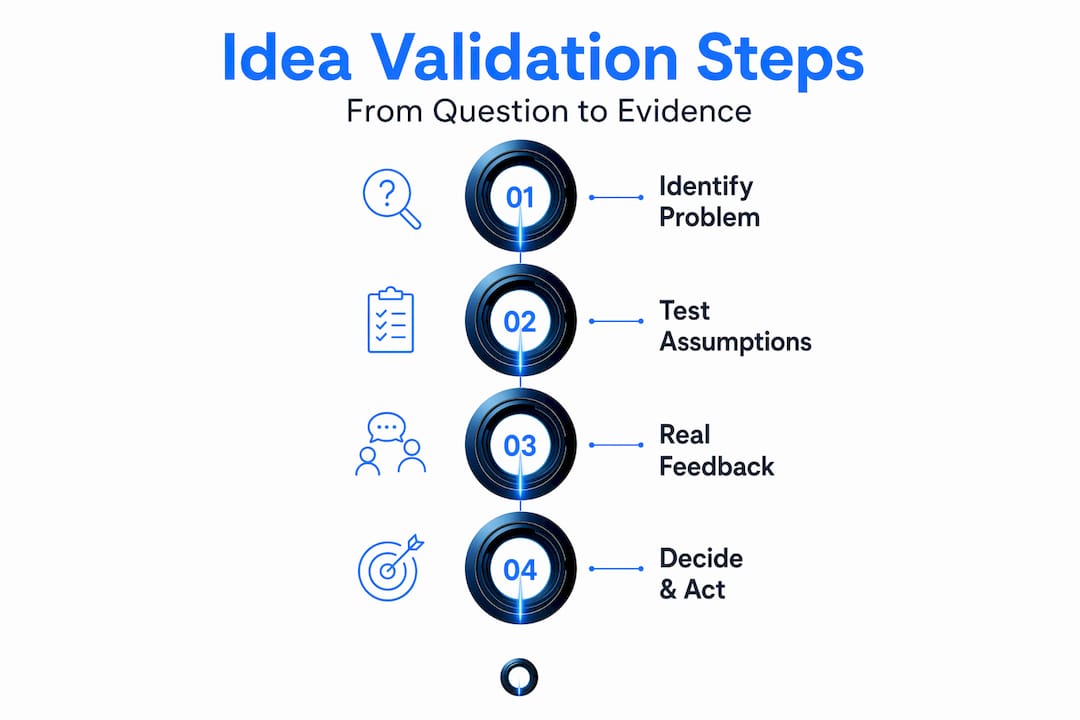
The idea validation process does not need to be expensive or slow. The 2-20-200 framework offers a structured, staged approach that manages your risk in proportion to your confidence level.
-
2 hours: Quick sanity check. Search Google Trends for the problem keyword. Check SEO volume. Look at Reddit threads and online forums to see how real people describe the pain. Review whether competitors exist. This stage costs nothing but attention, and it filters out ideas that have no market signal at all.
-
20 hours: Customer discovery. Conduct 10 to 15 interviews with people who match your target profile. Ask about their current behavior, not their opinions about your idea. Build a simple landing page that describes the problem and solution, and add a call to action such as a signup or pre-order. Run a small paid ad test to measure click-through rates and conversion.
-
200 hours: MVP development. Only reach this stage if the 20-hour phase produces strong positive signals. At this point you have real evidence of demand, not just enthusiasm. Building an MVP before this threshold means you are spending resources on hope rather than proof.
Validation can be done for under $200 and return results within 2 to 48 hours when the right methods are applied. That figure surprises most founders who assume validation requires expensive research agencies or months of work.
| Validation stage | Time investment | What you learn |
|---|---|---|
| 2-hour sanity check | 2 hours, $0 | Market size, competition presence, search demand |
| Customer discovery | 20 hours, under $200 | Problem severity, current workarounds, willingness to pay |
| MVP build | 200+ hours | Solution fit, conversion rates, retention signals |
Pro Tip: Design your 20-hour validation with a specific, binary outcome defined before you start. "If 3 out of 10 people try to pay me, I proceed. If fewer do, I pivot." Binary criteria eliminate wishful thinking.
A falsifiable test with specific success criteria and a time limit, such as generating five sales in 48 hours, gives you a clear pass or fail signal. That clarity is the entire point.
Common pitfalls that mislead founders
The startup idea testing methods that feel the most comfortable are often the least reliable. Understanding where validation goes wrong is as important as knowing what to do right.
Here is where most early-stage founders lose their way:
- Compliments from friends. "This is such a great idea" tells you nothing about purchasing intent. It tells you your friends are polite.
- Waitlist signups with no payment. A thousand email signups with no skin in the game are a vanity metric. Social approval has zero correlation with actual willingness to pay.
- Survey responses. People are terrible at predicting their own behavior. "Would you use this?" asked in a survey consistently overestimates real adoption.
- Positive investor interest. Investors say interesting things to avoid conflict. Until money changes hands, interest is not validation.
The behavior that counts is behavior with real stakes. Someone paying $29 upfront for early access is a real signal. Someone offering to introduce you to three colleagues they think would buy is a real signal. Someone spending 45 minutes walking you through their current painful workflow is a real signal.
"Your idea isn't unvalidated. It's untested. And there's a critical difference between the two."
One counterintuitive insight worth holding onto: competition is usually a good sign. If no one else is working on the problem, the most likely explanation is that no one is willing to pay to solve it. Competitors confirm that a real market exists. Your job is not to have no competition. It's to have a better angle.
Turning validation results into decisions
The best practices for idea validation are not complete until you connect the evidence to a decision. Validation without a decision framework is just expensive research. Here is how to interpret what you find.
| Validation outcome | What it signals | Recommended action |
|---|---|---|
| Strong willingness to pay, clear pain | Real market opportunity | Proceed to MVP, define positioning |
| Interest but no payment commitment | Problem exists, solution mismatch | Pivot the offer, retest |
| No interest, no problem recognition | Wrong audience or no market | Kill the idea or reframe completely |
| Mixed signals across segments | Multiple sub-markets | Narrow the audience, retest in one segment |
Startups with solid validation practices are 2.5 times more likely to succeed than those that skip the process. That figure reflects a structural advantage. Validated founders know their customer, their positioning, and their pricing before they write a line of code.
The pivot is not a failure signal. It is validation working correctly. If your interviews reveal that the real pain is one step removed from where you assumed, shifting your focus is the right response. The importance of idea validation lies precisely in generating this kind of redirecting evidence before you are too invested to use it.
Knowing when you have enough evidence to proceed requires a threshold. A reasonable benchmark: if 30% or more of your target conversations result in meaningful commitment, move forward. If you are below that, you need to retest with a refined hypothesis. Balancing genuine optimism with scientific rigor is not contradiction. It's what separates founders who scale from founders who burn out.
My take on why founders avoid real validation
I've watched dozens of founders go through this process, and the pattern is almost always the same. The ones who skip rigorous validation are not lazy. They are afraid. Real validation means genuinely risking the death of an idea they love, and most people would rather build something and fail slowly than ask hard questions and hear no.
What I've learned is that the founders who treat validation as a threat to their idea almost always suffer for it later. The ones who treat it as a tool to sharpen their idea, even if it redirects them completely, consistently land in better positions.
The uncomfortable truth is that the market does not care how good your idea is. It cares whether you are solving a problem it feels today, not a problem you assume it should have. I've seen technically brilliant products die because the founder validated the solution before the problem. And I've seen mediocre products scale because the founder understood exactly who was in pain and why.
Validation is not a box to check before you start building. It's an ongoing orientation toward evidence. The best founders I've encountered are relentlessly skeptical of their own assumptions, even after launch. That skepticism is not weakness. It's the thing that keeps them calibrated.
— Nate
Test your idea before you build it with Founderzero
You understand the validation process now. The harder part is actually running it without wasting time on the wrong questions or misreading the signals.
Founderzero was built specifically for this moment. It's an AI-driven platform that tests your startup idea against real market signals before you commit to building anything. If you already have an idea, Founderzero models buyer responses, maps demand signals, and identifies market gaps to tell you whether you're onto something real. If you don't have an idea yet, it uses your experience and strengths to generate concepts worth exploring. The free initial test gives you an immediate read on your best direction. No guesswork, no expensive consultants, no 18-month learning curve.
FAQ
What is idea validation in startups?
Idea validation in startups is the process of testing whether a real, painful problem exists in the market before investing resources in building a solution. It focuses on evidence from customer behavior, not assumptions or social approval.
How do I validate a startup idea quickly?
Use the 2-20-200 framework: spend 2 hours on basic market research, 20 hours on customer interviews and landing page tests, and only invest 200+ hours in building an MVP if both earlier stages show strong demand signals.
What counts as real validation evidence?
Real validation is any behavior with genuine stakes: someone paying for early access, placing a pre-order, or spending significant time explaining their problem to you. Compliments, survey responses, and waitlist signups without payment are not reliable validation signals.
Why is competition a good sign during validation?
Competitor presence confirms that people are willing to pay to solve the problem. A market with no competitors usually means no proven demand, not an open opportunity.
When should I stop validating and start building?
Start building when roughly 30% or more of your target interviews result in meaningful commitment, such as a payment or a formal pre-order. Below that threshold, refine your hypothesis and test again before committing development resources.