

You already have the raw material. The problem most aspiring entrepreneurs face isn't a shortage of talent — it's not knowing how to discover a business idea from skills they use every day without a second thought. A graphic designer who's been freelancing for years, a project manager who fixes broken team workflows in her sleep, a developer who can automate anything in an afternoon: each of them is sitting on a viable business and doesn't know it yet. This guide walks you through the exact process to identify, shape, and validate a business idea built entirely on what you already do well.
Table of Contents
- Understanding the skill-based business idea framework
- Preparing your skill inventory and target market
- Executing customer discovery to validate your idea
- Verifying demand and delivery with minimal investment
- Why most skill-based business ideas fail and how to succeed anyway
- Get expert support to discover and build your skill-based business
- Frequently asked questions
Key Takeaways
| Point | Details |
|---|---|
| Start with your skills | Assess your practical skills honestly to find a business idea that suits you best. |
| Define a narrow customer segment | Focus on a specific audience who truly needs your skill to increase your chance of success. |
| Validate through real conversations | Use structured interviews to understand customer problems and test demand before building. |
| Seek paid commitments | True validation comes from customers paying or pre-paying, not just expressing interest. |
| Avoid common pitfalls | Listen more, pitch less, and target decision-makers to get actionable feedback that guides your next steps. |
Understanding the skill-based business idea framework
The fastest path from "I want to start a business" to actual revenue isn't a breakthrough idea. It's a clear connection between what you already do, who needs it, and how you can deliver it repeatedly. A skill-based business idea should sit at the intersection of what you can do well, what others already need, and what you can package into a repeatable offer. That three-part test filters out the ideas that sound exciting but go nowhere.
When you start from competence rather than inspiration, you skip the steep learning curve that kills most early-stage ventures. You already know the terminology, the common problems, and the shortcuts. That's a real competitive edge, especially in the first six months when everything else is uncertain.
The practical skill categories worth examining fall into five buckets:
- Technical skills: Coding, data analysis, systems setup, financial modeling
- Creative skills: Writing, design, video production, brand development
- Communication skills: Coaching, facilitation, sales, public speaking
- Problem-solving skills: Consulting, process improvement, research, troubleshooting
- Organizational skills: Project management, operations, logistics, planning
Once you've identified your strongest skills, the next move is mapping each one to a specific buyer and a simple, repeatable offer. Most skill-based businesses start as services, which is exactly right. Services require almost no upfront investment, generate early cash flow, and give you direct feedback from paying clients. Over time, you can package what you've learned into digital products, templates, courses, or software.
Here's how that progression looks across different skill types:
| Skill | Target buyer | Initial offer | Scalable next step |
|---|---|---|---|
| Copywriting | SaaS founders | Email sequence rewrite | Email course or template pack |
| Data analysis | E-commerce brands | Monthly reporting dashboard | Automated analytics tool |
| Project management | Agency owners | Workflow audit and rebuild | Operations playbook or SOP library |
| Video editing | Online coaches | Course launch video package | Editing membership or tutorial course |
| Financial modeling | Early-stage startups | Pitch deck financial build | Model templates or CFO advisory retainer |
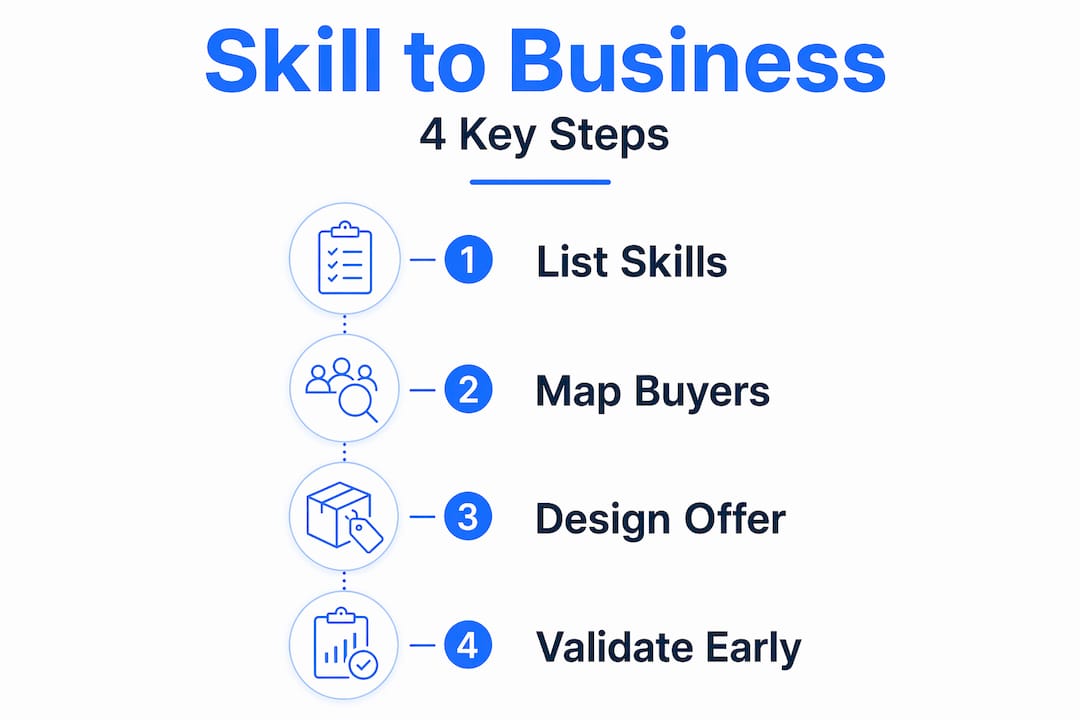
One mistake that consistently derails early entrepreneurs is trying to monetize every skill at once. Spreading across five offers to five different audiences means you generate no proof, no referrals, and no momentum. Pick one skill, one buyer, one offer.
Pro Tip: Start by selling a small, contained version of your service that delivers one measurable outcome. A copywriter doesn't need to offer full website rewrites on day one. A single landing page rewrite for a specific type of client, priced to close quickly, builds your first case study and your first referral.
Now that you understand the core framework, let's prepare by auditing your skills and defining your target buyer.
Preparing your skill inventory and target market
Before you can identify business opportunities from your skills, you need an honest picture of what you actually do well, not what your resume says or what sounds impressive. The goal here is practical competence, not credentials. Think about the last three times someone asked for your help at work or in your personal network. What did they ask for? That's often a stronger signal than any formal qualification.

To list your skills accurately, work through technical, creative, communication, problem-solving, and organizational categories and write down specific tasks you've completed, not just general labels. "I'm good at marketing" is useless. "I've run Facebook ad campaigns for local service businesses with budgets under $2,000 per month and consistently hit a 4x return" is a business.
Here's a structured way to build your skill inventory:
- List recent wins. Write down five things you did in the last 12 months that someone else found genuinely valuable.
- Note the recurring asks. What do colleagues, friends, or former clients come back to you for repeatedly?
- Identify the frustrations you solve. What problems do you fix that others find difficult or time-consuming?
- Flag what feels effortless. The tasks you complete in two hours that take others two days are your highest-leverage skills.
- Check for transferability. Can this skill serve a buyer outside your current employer or industry?
Once your skills are mapped, the next step is defining one specific customer segment. Not "small businesses." Not "entrepreneurs." One narrow group: solo e-commerce founders selling on Shopify, early-stage B2B SaaS companies with under 10 employees, or independent financial advisors trying to grow their client base. The more specific your segment, the faster you find them, the clearer your message, and the stronger your positioning.
Equally important: define who you are not serving. If you're targeting early-stage SaaS founders, you're explicitly excluding enterprise procurement teams, retail businesses, and anyone who needs a six-month onboarding process. This exclusion isn't limiting. It's clarifying.
Pro Tip: Use your most recent success story as your positioning anchor. If you helped a specific type of client solve a specific problem and got a measurable result, lead with that story when describing what you do. It's more convincing than any tagline.
With your skills mapped and target market defined, you're ready to execute early validation.
Executing customer discovery to validate your idea
Customer discovery is not about pitching. It's about listening to real behavior and confirming whether the problems you think exist are actually painful enough for someone to pay to solve. Most early entrepreneurs skip this step or do it wrong, which leads to building something nobody wants.
Before you schedule a single conversation, name the specific decision you want to make within the next one to two weeks. "I want to know if solo Shopify founders struggle with abandoned cart email sequences and would pay for someone to fix them." That decision focus keeps your interviews tight and your analysis useful.
Use a decision-first approach and aim for 25 to 40 structured conversations over 30 to 60 days. That volume sounds high, but it's what separates signal from noise. One enthusiastic conversation proves nothing. Twenty-five conversations with consistent patterns prove a lot.
Here's how to structure your outreach and interviews:
- Identify your segment precisely. LinkedIn, industry communities, and niche newsletters are your fastest paths to the right people.
- Request short calls. Fifteen to twenty minutes. No pitch, just questions.
- Open with context, not a product. "I'm exploring a problem I've noticed in your space and want to understand your experience."
- Ask about past behavior. "Tell me about the last time this was a problem for you." Not "Would you ever use a service like this?"
- Dig into workarounds. What are they doing right now to solve the problem? How much does it cost them in time or money?
- Listen for emotional language. Words like "frustrating," "always," "never," and "I've tried everything" signal real pain.
- Test willingness to pay. "If I could solve this for you in the next two weeks, what would that be worth?"
The questions you don't ask matter as much as the ones you do. Avoid hypotheticals. "Would you use a tool that..." is nearly worthless because people answer based on what sounds reasonable, not what they'd actually do.
Pro Tip: Aim to speak less than 20% of the time on each call. Your job is to hear how the problem shows up in their words, not to explain your solution. The language they use will become your marketing copy.
Once you have these validated insights from customer discovery, the next step is to verify your business idea with real commitment.
Verifying demand and delivery with minimal investment
Positive feedback from customer discovery is encouraging. It's not validation. Real validation for service businesses means securing actual contracts or prepaid engagements, not a string of "this sounds great" responses. The moment someone hands you money or signs an agreement, the signal quality jumps by an order of magnitude.
The fastest way to test this is a small paid pilot. Offer to solve one specific problem for one specific client at a reduced rate in exchange for a case study and honest feedback. Keep the scope narrow enough that you can deliver it in one to two weeks. The goal isn't profit yet. It's proof.
While you're delivering, track everything:
- How long does each task actually take?
- Which parts of the service create the most visible value for the client?
- Where do you run into unexpected friction?
- What questions does the client keep asking that you hadn't anticipated?
This data shapes your offer, your pricing, and your process for the next client.
Here's a clear comparison of what different validation stages actually tell you:
| Validation stage | What it tells you | What it doesn't tell you |
|---|---|---|
| Conversations only | Problem exists and is recognized | Whether anyone will pay to solve it |
| Verbal commitments | Interest is real | Whether they'll follow through |
| Paid pilots | Demand is real and delivery is possible | Whether it scales beyond early adopters |
| Repeat clients and referrals | You have a repeatable, valuable offer | Final pricing ceiling or growth ceiling |
Watch for behavioral signals beyond payment. A client who follows up before you do, refers a colleague without being asked, or asks about your availability for next month is showing you something a survey never could.
Pro Tip: The friction you encounter during your first paid delivery is your product roadmap. Every workaround you build, every question you answer twice, every step that takes longer than expected is a feature, a template, or a process improvement waiting to be built.
After verifying your idea with minimal investment, you will understand whether to proceed, pivot, or pause.
Why most skill-based business ideas fail and how to succeed anyway
Here's the uncomfortable pattern: most aspiring entrepreneurs who try to turn skills into business ideas fail not because their skills are weak, but because they validate the wrong thing. They collect opinions instead of decisions. They talk to enthusiastic non-buyers. They mistake "I'd love something like that" for "I will pay for this now."
Many founders mistake customer discovery for casual user conversations, which leads to wasted months and wrong bets. The fix isn't more conversations. It's better ones, with the right people, focused on behavior rather than sentiment.
The other failure mode is trying to turn every skill into a business simultaneously. A person who can write, design, coach, and analyze data doesn't have four business ideas. They have one good one and three distractions. The discipline to pick one skill, one buyer, and one offer and go deep on it before expanding is what separates the founders who get their first client in 30 days from the ones still "figuring out their niche" six months later.
There's also the delivery trap. Some entrepreneurs do the discovery work, get positive signals, and then delay delivery because they want everything to be perfect first. This is where false validation lives. You don't actually know if you can deliver value sustainably until you've done it under real conditions, with a real client, on a real deadline.
The practical wisdom here is simple: payment and delivery are the only two validation signals that matter in the early stage. A compliment is not a contract. Treat validation as a continuous cycle of learning, deciding, and acting quickly, not a one-time checkpoint before you build.
Pro Tip: After each pilot delivery, run a five-minute debrief with yourself. What worked? What took twice as long as expected? What would you charge more for next time? This habit compounds fast and builds founder insights that no framework can replace.
Get expert support to discover and build your skill-based business
Now that you know how to discover and validate your skill-based business idea, here's how Founder Zero can help you move faster and with confidence.
Knowing the framework is one thing. Executing it without burning weeks on the wrong assumptions is another. Founder Zero is built specifically for entrepreneurs at this exact stage: you have skills, you have ambition, and you need a clear, data-informed path from idea to first paying client.
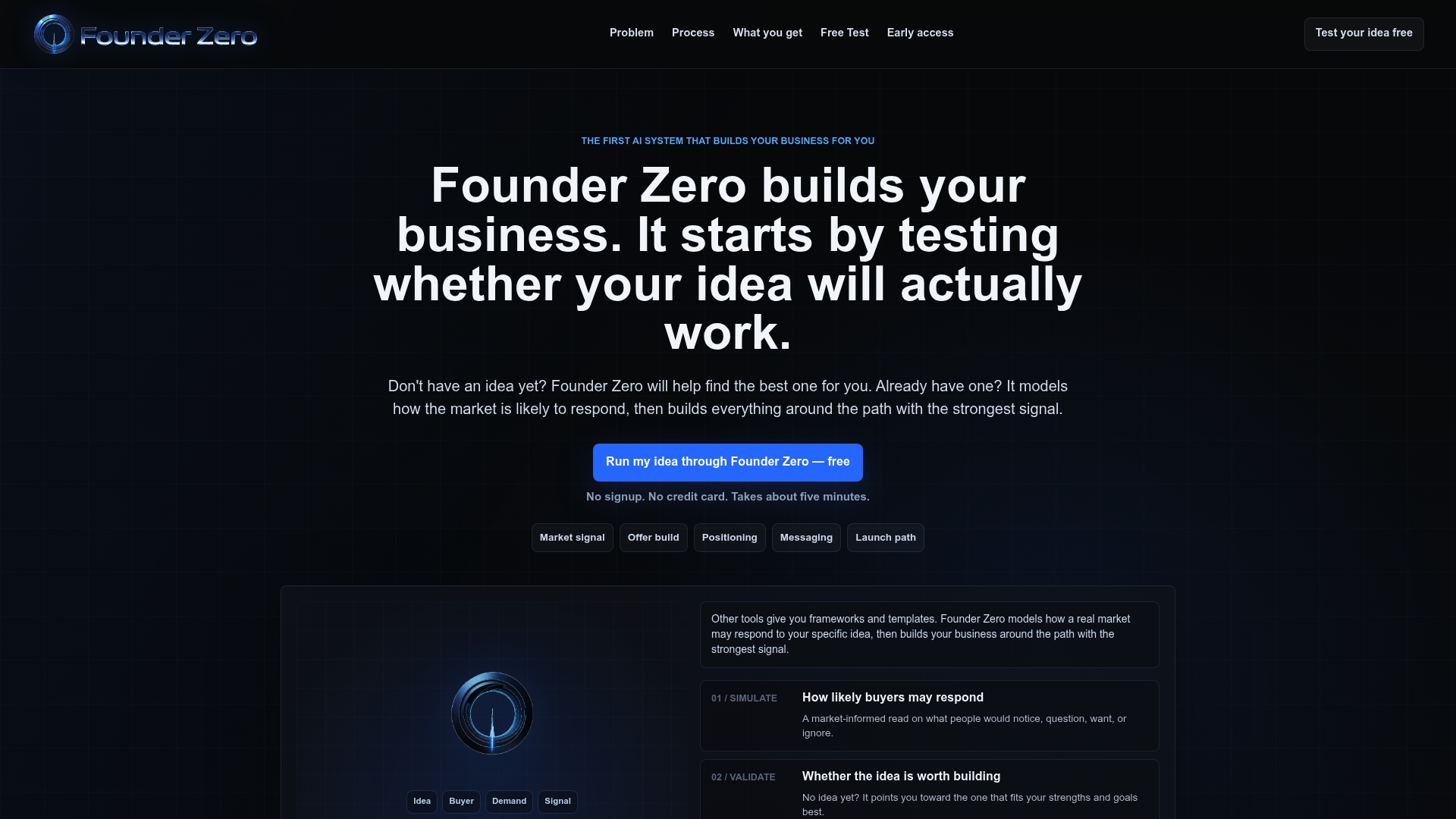
The Founder Zero platform starts with a free test that assesses your strongest business direction based on your skills, experience, and preferences. If you already have an idea, it models buyer responses and market gaps before you invest a dollar. If you don't have an idea yet, it surfaces the most promising concepts based on what you bring to the table. From there, the platform sequences your launch path, tells you what to build first, and tracks the metrics that actually matter. No guesswork. No building the wrong thing for the wrong market.
Frequently asked questions
How do I start discovering a business idea from my skills?
Begin by auditing your practical skills across technical, creative, communication, problem-solving, and organizational categories, then identify one specific customer segment that benefits most and package a simple, testable offer. List your skills by task and outcome, not just job title.
What is the main goal of customer discovery for early entrepreneurs?
The main goal is to make validated decisions about which problems to solve and for whom, based on real customer behavior rather than opinions. Customer discovery is the process of confirming that a real group of people has a painful, recurring problem your skills can solve.
How do I know if my skill-based business idea is validated?
You have validation when real customers commit with payment or signed agreements, you can deliver the service sustainably, and you see repeatable buyer behavior like referrals and follow-up requests. Validation happens when customers pay or pre-pay and when delivering the service repeatedly is feasible.
Can I test multiple business ideas from my skills at once?
It's more effective to use a two-gate approach: first validate problem-founder fit on one idea, then compare long-term potential among options. Filter for fit first, then evaluate competing ideas once you have real signal on at least one.
What common mistakes should I avoid during customer discovery?
Avoid pitching instead of listening, talking to people without buying power, asking hypothetical questions, and stopping at "interesting" without pushing for actionable insights. Common pitfalls include broad audiences, single interviews, and treating enthusiasm as evidence.