

You do not need to write code to build a profitable startup. The landscape for business ideas for non-technical founders has never been more accessible, yet most aspiring entrepreneurs still get stuck choosing between ideas they cannot execute and ideas too small to matter. Nearly 35% of startups fail from poor product-market fit, which means the real risk is not your technical skill level. It is launching the wrong idea without validating it first. This guide gives you a clear framework for evaluating ideas, concrete options across multiple business models, and a side-by-side comparison so you can choose with confidence.
Table of Contents
- How to evaluate business ideas as a non-technical founder
- Low-cost service-based businesses with quick revenue
- Niche e-commerce and high-margin digital products
- MicroSaaS and AI-driven product ideas for non-technical founders
- Comparing business ideas for non-technical founders: a side-by-side summary
- Choosing the right business idea: situational recommendations
- Why non-technical founders' unique constraints can be a competitive advantage
- Build your startup with confidence using Founder Zero
- Frequently asked questions
Key Takeaways
| Point | Details |
|---|---|
| Validate early | Use customer interviews and landing page tests to confirm demand before building a product. |
| Start with services | Low-cost, service-based businesses can generate revenue quickly for non-technical founders. |
| Leverage no-code | No-code tools and sprint agencies make launching SaaS possible without technical skills. |
| Control scope | Define fixed scopes in productized services to maintain high margins and avoid scope creep. |
| Focus on fit | Research competitors and customers thoroughly to ensure strong product-market fit and reduce failure risk. |
How to evaluate business ideas as a non-technical founder
Before you fall in love with any idea, you need a filter. Most startup ideas for beginners fail not because the founder lacked hustle, but because nobody wanted the thing badly enough to pay for it. Evaluation is not glamorous, but it is the work that separates founders who get customers from founders who get feedback too late.
Here is what to assess before committing:
- Problem clarity: Can you describe the problem in one sentence, from the customer's point of view?
- Competitor evidence: Are others already selling a solution? Competitors are proof of demand, not a reason to walk away.
- Willingness to pay: Have you talked to ten potential customers and asked what they currently spend to solve this problem?
- Time to revenue: How many weeks before you can realistically invoice someone?
- Startup cost: What is the minimum you need to spend before earning your first dollar?
- Your unfair advantage: Do you have domain knowledge, relationships, or a distribution channel others do not?
The validation frameworks for non-technical founders that actually work all share one trait: they test real behavior, not stated preferences. Someone saying "I would pay for that" is worthless. Someone handing you a credit card is data.
Pro Tip: Use a concierge MVP before building anything. Deliver your service or product manually to your first five customers. This costs almost nothing and reveals whether people value the outcome enough to pay, which is the only question that matters before you spend a dollar on development.
Low-cost service-based businesses with quick revenue
Service-based businesses are the most forgiving entry point for non-tech entrepreneur ideas. You trade time and expertise for money, the startup cost is minimal, and you can have a paying customer within weeks. The tradeoff is that your time is finite, so growth requires either raising prices or productizing your offer.
Strong options in this category include:
- Social media management: Businesses need consistent content but rarely have someone dedicated to it. You manage posting, engagement, and basic analytics for a monthly retainer.
- Content editing and copywriting: Companies producing blogs, newsletters, or marketing materials always need skilled editors. No technical skill required, just strong written communication.
- Virtual assistance: Administrative support, inbox management, calendar coordination, and research tasks are in constant demand from solo founders and small teams.
- Bookkeeping support: With basic training in tools like QuickBooks or Wave, you can offer financial organization services to small businesses that cannot afford a full-time accountant.
- Freelance project management: Businesses running product launches, events, or campaigns need someone to coordinate moving parts. This is a skill, not a technical one.
Many online businesses like social media management can launch for under $100 with revenue generation within weeks. The barrier is not money. It is positioning yourself credibly enough to charge what the work is worth.
Productized services have startup costs under $500, time to first paying customer of two to four weeks, and margins that hold up even during slow months. The key word is "productized." A generic freelance offer competes on price. A packaged service with defined deliverables, a fixed price, and a clear outcome competes on value.

Pro Tip: Stop selling your time by the hour. Build a service package with a fixed monthly price and a defined scope. "Three posts per week, one analytics report per month, and a 30-minute strategy call" is a product. "Social media help" is a commodity. Packages are easier to sell, easier to scale, and much easier to raise prices on.
Niche e-commerce and high-margin digital products
Beyond services, non-tech startups can build real asset value through products. The distinction matters because a product can generate revenue while you sleep. A service cannot.
Physical niche e-commerce is accessible but carries more complexity. You are managing inventory, shipping, returns, and supplier relationships. Niche e-commerce businesses like specialty foods, personal care, and branded apparel carry margins of 50 to 70 percent with startup costs between $3,000 and $15,000. That is real money at risk before you know whether the market wants your product.
Digital products are a different story. Online courses, ebooks, and templates carry margins of 80 to 95 percent with startup costs under $500. You create the product once and sell it repeatedly. The challenge is audience. Without an existing following or a paid acquisition strategy, digital products can sit unsold indefinitely.
Here is how the two models compare:
| Factor | Niche e-commerce | Digital products |
|---|---|---|
| Startup cost | $3,000 to $15,000 | Under $500 |
| Gross margin | 50 to 70% | 80 to 95% |
| Time to first sale | 4 to 8 weeks | 1 to 3 weeks |
| Inventory risk | High | None |
| Scalability | Moderate | High |
| Technical skill needed | Low to moderate | Low |
| Audience required | Moderate | High |
The validation frameworks for non-technical founders that work best here involve selling before you fully build. Post a pre-sale for your digital product. Run a small paid ad to a landing page. If nobody buys at a small scale, do not build the full course.
Pro Tip: Sell a $27 to $97 digital product before building anything larger. A short checklist, a template pack, or a focused mini-guide validates demand without months of content creation. If it sells, you have proof. If it does not, you have learned cheaply.
MicroSaaS and AI-driven product ideas for non-technical founders
MicroSaaS sounds technical, but the concept is simple: a small software tool that solves one specific problem for a niche audience, priced as a monthly subscription. The "micro" part is the point. You are not building Salesforce. You are building the one feature Salesforce forgot for dental office managers.
Non-technical founders using sprint-based agencies can go from a validated idea to a live SaaS product in 30 days using five to seven day build sprints. You define the problem and the customer. The agency builds the first version. You sell it.
Successful non-technical SaaS founders rely on off-the-shelf tools for authentication and billing instead of custom builds. Stripe handles payments. Auth0 handles logins. Your job is the problem, the positioning, and the customer relationships.
AI literacy workshops are another strong play. 78% of companies used AI in 2025, and most of their employees have no idea how to use it effectively. If you understand how to apply AI tools to business workflows, you can charge $500 to $2,000 per workshop to train teams. No coding required.
Steps to validate and launch a microSaaS as a non-technical founder:
- Identify a workflow problem in an industry you know well.
- Talk to ten people in that industry and confirm they currently pay to solve it.
- Sketch the solution on paper. One core feature, not five.
- Build a landing page and collect email signups or pre-payments.
- Hire a sprint-based agency or no-code developer to build the MVP.
- Launch to your waitlist and charge from day one.
- Iterate based on what paying customers actually use.
Productized services convert into the highest founder hourly rate of any starter category, with margins of 70 to 90 percent. MicroSaaS can eventually surpass that, but it takes longer to reach profitability.
Pro Tip: Build your microSaaS in an industry where you already have relationships. Domain expertise is not a nice-to-have. It is your distribution channel. You already know who to call, what they complain about, and who they trust.
Comparing business ideas for non-technical founders: a side-by-side summary
Here is a clear comparison of the main business models covered, so you can match options to your actual situation:
| Business model | Startup cost | Time to revenue | Gross margin | Technical skill | Scalability |
|---|---|---|---|---|---|
| Productized service | Under $500 | 2 to 4 weeks | 60 to 80% | None | Moderate |
| Niche e-commerce | $3,000 to $15,000 | 4 to 8 weeks | 50 to 70% | Low | Moderate |
| Digital products | Under $500 | 1 to 3 weeks | 80 to 95% | Low | High |
| MicroSaaS | $5,000 to $20,000 | 8 to 16 weeks | 70 to 90% | Low (with agency) | Very high |
| AI literacy workshops | Under $500 | 1 to 2 weeks | 85 to 95% | None | Moderate |
Key risks to watch for across all models:
- Scope creep: Clients always ask for more. Define your deliverables in writing before you start.
- Audience dependency: Digital products and microSaaS require an audience or paid acquisition budget. Factor this in before you build.
- Pricing too low: Most first-time founders underprice. Start higher than feels comfortable. You can always discount. Raising prices on existing clients is painful.
- Skipping validation: Every model here benefits from the validation frameworks for non-technical founders that test demand before significant investment.
Choosing the right business idea: situational recommendations
The best business idea is not the most exciting one. It is the one you can actually execute given your time, budget, relationships, and risk tolerance. Here is how to think through it:
- If you have under $500 and need revenue fast: Start with a productized service in a category where you have existing skills. Get one paying client within two weeks. Reinvest from there.
- If you have domain expertise in a specific industry: Consider a microSaaS or AI workshop. Your knowledge is the moat. Use it.
- If you have an existing audience: Digital products are your fastest path to high-margin revenue. Sell before you build.
- If you prefer products over client work: Start with niche e-commerce, but validate with a small inventory run before committing to large orders.
- If you are completely unsure where to start: Run customer interviews in three industries you know. The one where people complain most vividly about an unsolved problem is your market.
78% of companies used AI technologies in 2025, which means AI literacy workshops represent a genuine gap in the market right now. If you have spent any time learning AI tools for business, you are already ahead of most corporate teams.
Pro Tip: Before you commit to any model, run a concierge MVP. Offer the service or product manually to three to five customers. Charge them. Deliver it by hand. You will learn more in two weeks than six months of planning will teach you.
Why non-technical founders' unique constraints can be a competitive advantage
Here is the contrarian view most startup content will not tell you: not knowing how to code might actually make you a better founder.
Technical founders build. That is their instinct. When a problem appears, they write code. The result is often a product that is technically impressive and commercially confused. Non-technical founders cannot default to building. They are forced to talk to customers, validate assumptions, and find the simplest possible solution. That constraint produces better product decisions.
Successful non-technical SaaS founders treat their non-technical nature as a design constraint, not a disability. They reach for off-the-shelf tools first. They use Stripe instead of custom billing. They use Airtable instead of a custom database. The result is a product that launches faster, costs less, and stays focused on the problem that actually matters.
The concierge MVP stage, where you deliver manually before automating, is where non-technical founders genuinely excel. You are in direct contact with customers. You see exactly where the friction is. You learn what they value and what they ignore. A technical founder would have automated that process before learning any of it.
Non-technical founders also tend to build better business plans because they cannot hide behind technical complexity. Every decision has to make commercial sense. That discipline, applied consistently, produces leaner and more profitable startups with real market fit. The constraint is the advantage. Design around it intentionally.
Build your startup with confidence using Founder Zero
You now have a clear picture of which business models fit your skills, budget, and timeline. The harder part is knowing whether your specific idea has real demand before you invest weeks of effort into it.
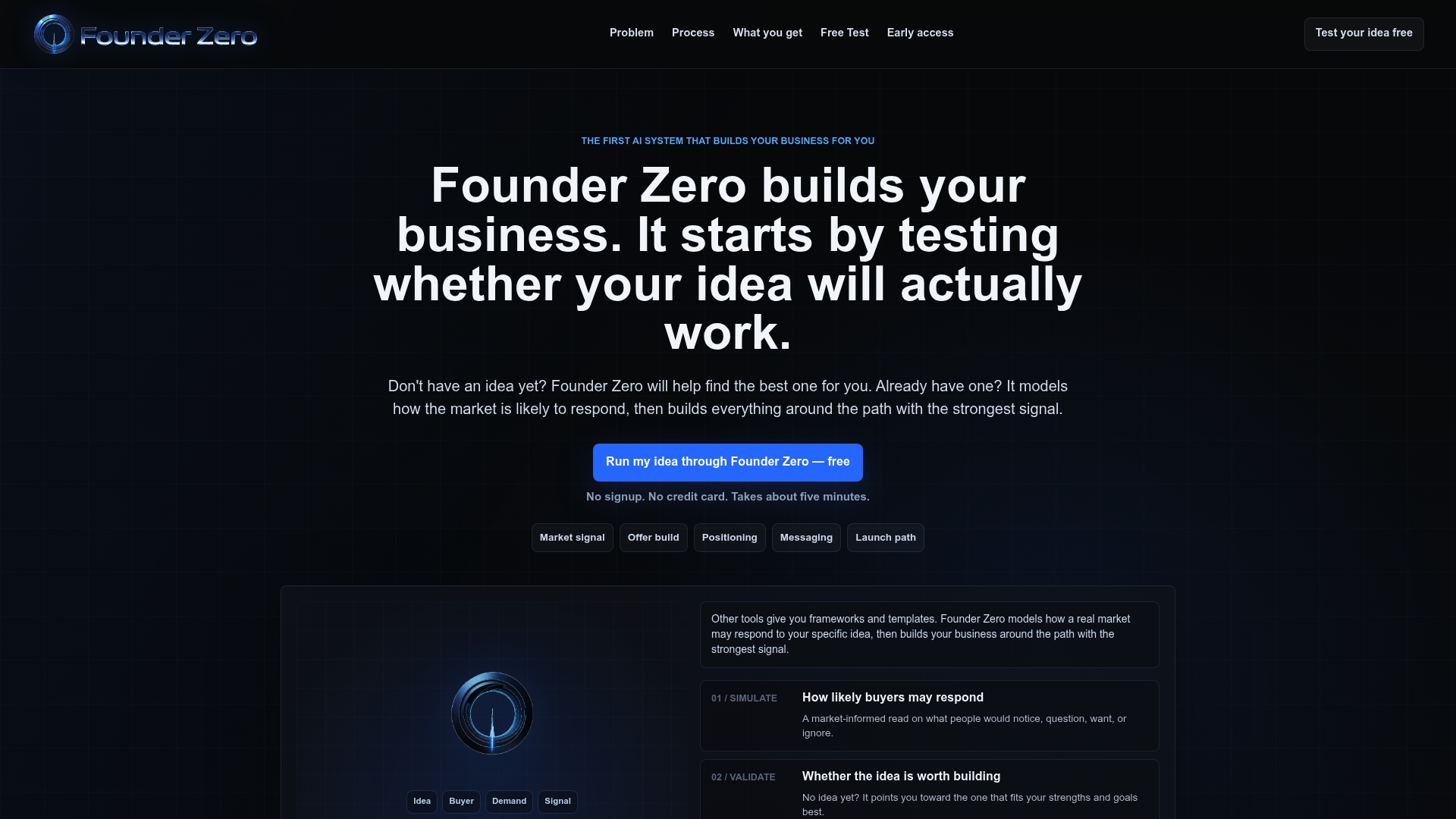
Founder Zero's startup validation framework is built specifically for non-technical founders who want data before they commit. The platform tests your idea against real market signals, models buyer behavior, and tells you whether you are chasing a real opportunity or a crowded dead end. If you do not have an idea yet, Founder Zero uses your background and preferences to surface the best options for you. Start with a free assessment and get an immediate read on your best business direction, then use the full plan to go from idea to paying customers with far less guesswork.
Frequently asked questions
What are the most viable business ideas for non-technical founders with low startup costs?
Service-based businesses like social media management and content editing can start under $500, with revenue within weeks and no technical skills required. Productized versions of these services command higher prices and better margins.
How can non-technical founders validate their business ideas before building a product?
Use customer interviews, landing page tests, and concierge MVPs to confirm demand. Landing page tests take one to two weeks, and an 8% or higher conversion rate combined with three to five pre-payments signals real willingness to pay.
What are productized services and why are they recommended for non-technical founders?
Productized services are packaged offerings with fixed scope, fixed pricing, and defined deliverables. They have startup costs under $500 and time to first paying customer of two to four weeks, making them ideal for founders without technical backgrounds.
Is technical expertise necessary to build a SaaS product as a non-technical founder?
No. Sprint-based agencies can take a validated idea to a live SaaS product in 30 days using five to seven day build sprints, with the founder focused on customers and positioning rather than code.
Why is validating product-market fit critical for startup success?
Nearly 35% of startup failures stem from poor product-market fit. Conducting customer interviews and competitor analysis before building dramatically reduces the risk of launching something the market does not want.