

Choosing your first business model is one of the most consequential decisions you'll make as an entrepreneur, and most people get it wrong by defaulting to products. The benefits of starting a service-based business are substantial and often underestimated. You can generate revenue within days, not months. You need no warehouse, no inventory, and no manufacturing line. Yet many aspiring founders still hesitate, convinced that a "real" business sells something physical. This article breaks down exactly why service businesses are one of the most financially sound and personally rewarding paths into entrepreneurship, with honest caveats included.
Table of Contents
- Key Takeaways
- 1. The core benefits of starting a service-based business start with low costs
- 2. You can reach your first paying client within days
- 3. Flexibility and control over your schedule
- 4. High profit margins that product businesses rarely match
- 5. Client relationships create compounding revenue
- 6. Service businesses build the foundation for product development
- 7. Service businesses are ideal for testing entrepreneurship itself
- My honest take on why service businesses work
- How Founderzero helps you build your service business right
- FAQ
Key Takeaways
| Point | Details |
|---|---|
| Near-zero startup costs | Service businesses eliminate inventory and manufacturing, letting you generate income with skills you already have. |
| Faster path to revenue | You can land your first paying client within days by pre-selling before building any infrastructure. |
| Strong profit margins | Low overhead combined with value-based pricing creates margins that most product businesses cannot match. |
| Client loyalty drives growth | Deep relationships and repeat business reduce your marketing costs and create predictable income over time. |
| Hybrid model potential | Service revenue can fund product development, giving you a resilient, scalable business long-term. |
1. The core benefits of starting a service-based business start with low costs
No other business model gets you from idea to income faster. Service businesses eliminate manufacturing, warehousing, and shipping costs that product businesses carry from day one. A freelance copywriter needs a laptop and a Wi-Fi connection. A business consultant needs expertise and a phone. A bookkeeper needs accounting software that costs less per month than a single dinner out.
This matters enormously for cash flow. When you are not spending thousands on inventory before making a single sale, your risk exposure is minimal. You can test whether your offer resonates with real buyers before committing to any significant expense.
- No inventory to purchase or store
- No manufacturing equipment or production costs
- No shipping logistics or fulfillment infrastructure
- Minimal software tools, most of which have free tiers
- Your primary asset is knowledge or skill you already possess
Pro Tip: Pre-sell your service before you build a website, write a proposal, or design a logo. Getting a verbal or written commitment from one real prospect validates your idea faster than any amount of market research.
2. You can reach your first paying client within days
Speed to market is one of the most overlooked advantages of service businesses. While a product founder spends months on prototyping, sourcing, and compliance, a service founder can send five outreach messages today and have a paid project by Friday.

This rapid feedback loop is critical. You learn what the market actually wants, not what you think it wants. Many beginners stall by over-investing in branding before they have a single client. The smarter move is to secure early client commitments first, then build the brand around what you learn from those early engagements.
The speed advantage also reduces psychological pressure. When revenue arrives quickly, you stay motivated. When months pass with no income, most people quit. Service businesses protect you from that early-stage burnout trap.
3. Flexibility and control over your schedule
This is where the advantages of service businesses get personal. You choose your hours. You choose your clients. You choose where you work. That level of autonomy is genuinely rare, and it is one of the primary reasons people pursue the benefits of freelance work and independent service businesses.
Consider what that flexibility looks like in practice:
- You schedule client calls during your peak energy hours, not during a commute
- You take on projects that align with your values and interests
- You work from home, a coffee shop, or a different country entirely
- You scale up during high-income months and pull back when life demands it
- You say no to difficult clients without asking anyone's permission
The caveat here is real. Flexibility without discipline becomes chaos. You need to treat your schedule with the same respect you would give a traditional employer. Set working hours, protect them, and communicate boundaries to clients from the start. Freedom is only an asset if you manage it deliberately.
4. High profit margins that product businesses rarely match
Low overhead is the engine behind strong margins. When your primary cost is your time and a handful of software subscriptions, a large percentage of every dollar you earn stays in your pocket. A product business might operate on 20 to 40 percent margins after manufacturing, shipping, and returns. A service business can operate at 70 to 90 percent margins, especially once you are established.
The key is how you price. Many new service providers make the mistake of charging by the hour, which caps their income at the number of hours they can work. Pricing based on value, not just time, changes the entire equation.
| Pricing model | Income ceiling | Margin potential | Best for |
|---|---|---|---|
| Hourly billing | Limited by hours available | Moderate | Early-stage, simple projects |
| Fixed-price packages | Higher, predictable | High | Defined scope, repeatable work |
| Monthly retainers | Recurring, scalable | Very high | Ongoing client relationships |
| Value-based pricing | Uncapped | Highest | Expert positioning, outcomes |
Pro Tip: Moving from hourly to retainer models is not just a pricing change. It is a business model shift that decouples your income from the number of hours you can physically work. Do it as soon as you have a client who values consistent access to your expertise.
The premium service sector reinforces this point. Luxury services capture market share by meeting consumer demand for extraordinary experiences, and clients in these segments pay premium prices with high loyalty. You do not need to serve everyone. You need to serve the right people exceptionally well.
5. Client relationships create compounding revenue
Products get purchased once. Services get renewed, expanded, and referred. That difference in customer behavior is one of the most powerful service business success strategies available to you, and it is built into the model itself.
Deep client relationships in service businesses generate repeat business and referrals more effectively than product sales alone. A satisfied client does not just come back. They send their colleagues, their friends, and their network. Your marketing cost per new client drops with every strong relationship you build.
Here is what drives that loyalty:
- Personalized attention that clients cannot get from a software product or a commodity service
- Consistent communication that makes clients feel heard and prioritized
- Delivering outcomes rather than just completing tasks, which builds trust-based relationships over time
- Proactive problem-solving that positions you as a strategic partner, not just a vendor
One risk to manage actively is scope creep. Clear written agreements that define deliverables protect both you and your client. When scope changes happen, and they will, you have a documented baseline to reference. Without it, you end up doing more work for the same pay, which erodes both your margins and your enthusiasm for the client relationship.
6. Service businesses build the foundation for product development
Pure time-for-money models have a ceiling. You can only work so many hours, and at some point, growth requires either raising prices significantly or hiring people. That is why the smartest service business owners use their early revenue and client insights to build scalable products on the side.
Combining service revenue with product development creates resilience. Your service income funds innovation without requiring outside investment. Your client relationships give you direct access to real problems worth solving. You are not guessing at product-market fit. You are building it from the inside.
| Business stage | Revenue source | Strategic purpose |
|---|---|---|
| Early | Service contracts only | Validate demand, build cash flow |
| Growth | Services plus digital products | Expand income without adding hours |
| Scale | Retainers plus productized offers | Predictable revenue, reduced delivery time |
| Mature | Products supported by premium services | Maximum margin, market authority |
Recurring revenue models provide long-term financial stability and easier growth planning. When you combine that with a product that generates passive income, you have built something that can grow without requiring your constant presence.
7. Service businesses are ideal for testing entrepreneurship itself
Before you commit to a complex business structure, a service business lets you practice every core entrepreneurial skill in a low-stakes environment. You learn to sell, to price, to manage client expectations, to deliver under pressure, and to handle the administrative side of running a business. All of this happens while you are generating real income.
The service industry growth potential is also significant across nearly every sector. Consulting, coaching, marketing, design, legal services, financial advising, software development, and dozens of other categories are all growing. You are not entering a shrinking market. You are entering one where service has become the core brand differentiator and the primary way customers experience a business over time.
This is why service businesses are an ideal starting point for first-time entrepreneurs. The skills you build, the clients you serve, and the reputation you develop all compound over time into something that is genuinely hard to replicate.
My honest take on why service businesses work
I've watched a lot of people overthink their way out of starting. They want the perfect brand, the perfect website, the perfect offer before they talk to a single potential client. I've learned that the business model itself is rarely the problem. Pricing confidence and scope management are where most service entrepreneurs struggle in the first year.
What I've found is that the founders who succeed early share one habit: they ask for the sale before they feel ready. They send the proposal before the website is live. They name a price before they have a case study to back it up. That discomfort is the actual work of entrepreneurship, and a service business forces you to face it immediately.
My other observation is that burnout in service businesses almost always traces back to underpricing. When you charge too little, you resent the work. You take on too many clients to compensate. You stop delivering at your best. Raising your prices is not just a financial decision. It is a quality-of-work decision. The clients who pay more tend to respect your time more, follow your advice more, and refer better clients in return.
Start with a service. Build the reputation. Then let the revenue and the client insights tell you what to build next.
— Nate
How Founderzero helps you build your service business right
Starting a service business is one of the clearest paths to entrepreneurship, but knowing which service to offer, how to position it, and who to target first is where most people get stuck.
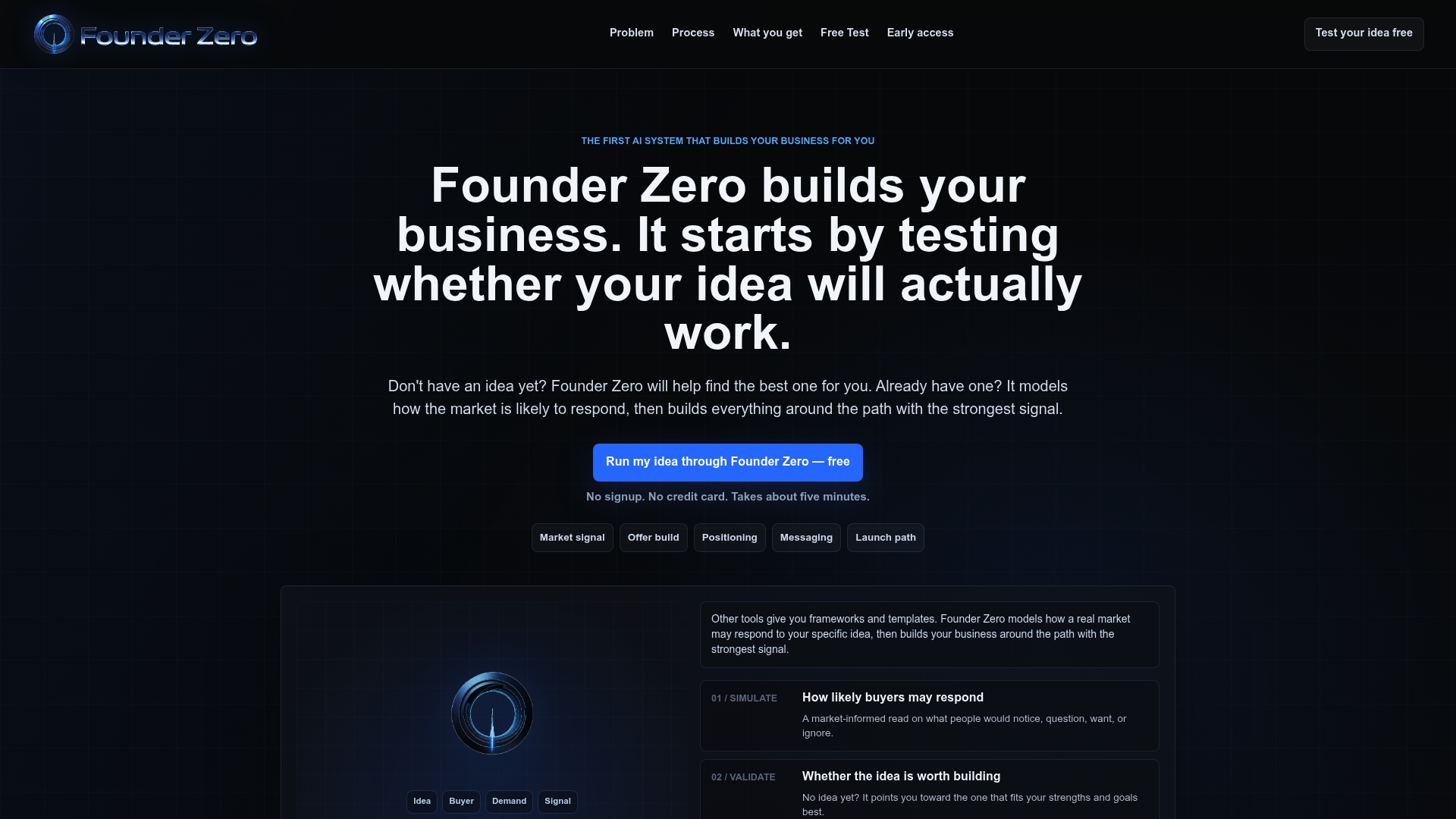
Founderzero is an AI-driven platform built specifically for this moment. It starts by testing your business idea against real market signals before you invest time or money. If you do not have an idea yet, it uses your skills, experience, and preferences to surface the strongest options. From there, it models buyer demand, identifies market gaps, and builds out your positioning and launch sequence.
The free initial test gives you an immediate read on your best business direction. The paid plan generates a ready-to-launch business plan tailored to your specific offer. If you are serious about starting a service business with confidence rather than guesswork, Founderzero is the place to begin.
FAQ
What are the main benefits of starting a service-based business?
The primary benefits include low startup costs, fast path to revenue, high profit margins, and the ability to build strong client relationships that generate repeat business and referrals. Service businesses require minimal capital because they rely on expertise rather than inventory or manufacturing.
How much money do I need to start a service business?
Many service businesses can be started with less than a few hundred dollars, covering basic software tools and a simple online presence. Because there is no inventory or production cost, your primary investment is time and skill.
How do I scale a service business beyond trading time for money?
Transitioning from hourly billing to fixed-price packages or monthly retainers decouples your income from the hours you work, which is the most direct path to scaling a service business without burning out.
What is the biggest risk in a service-based business?
Scope creep is one of the most common and costly risks. Without clear written agreements defining deliverables and change processes, you can end up doing significantly more work than you are paid for, which erodes both profitability and client satisfaction.
Is a service business better than a product business for beginners?
For most first-time entrepreneurs, yes. Service businesses generate revenue faster, require less capital, and teach core business skills in a real-world environment without the complexity of supply chains, inventory management, or product development timelines.